Reverse mortgage calculator
Reverse Mortgage Calculator (2026 HECM Limits)
Estimate what an FHA-insured Home Equity Conversion Mortgage (HECM) might provide, using HUD's principal limit factors and the 2026 maximum claim amount of $1,249,125 (HUD Mortgagee Letter 2025-22 (opens hud.gov in a new tab)). Estimate only. Not a loan offer or a quote.
This material is not from HUD or FHA, and it was not approved by HUD, FHA, or any other government agency. National Mortgage Center and Stride Bank, N.A. are not affiliated with HUD or FHA.
You must continue to pay property taxes, homeowners insurance, and maintain the home, or the loan may become due.
Estimate only
See an estimate with no email required
Real-Time Updates
Results change as you adjust your inputs
Talk With a Loan Officer
Review your numbers with a federally registered mortgage loan originator
- No sign-up needed to see results
- Updated 2026-09-25
- Equal Housing Lender · NMLS #466690 (verify)
Educational estimate, not a loan offer.
Reverse Mortgage (HECM) Calculator
Estimate only. Uses HUD principal limit factors and the 2026 maximum claim amount of $1,249,125 (HUD Mortgagee Letter 2025-22).
Your Home and Loan
Sample values shown. Replace them with your own.
Use the youngest borrower or eligible non-borrowing spouse.
Adjustable: 10-year index + lender margin. Fixed: the note rate. This is your assumption, not a quote. APR is not shown.
Appraisal, title, recording, counseling, and similar.
Principal limit $176,850 minus closing costs and existing liens paid at closing
Ways to Receive Your Proceeds
Each option below is an alternative, not an addition. Payment plans shown are for adjustable-rate HECMs. A fixed-rate HECM pays a single lump sum at closing only.
Closing Costs and Payoffs
- Initial FHA mortgage insurance (2% of max claim)
- $9,000
- Origination fee (HUD maximum)
- $6,000
- Other closing costs
- $3,500
- Existing liens paid off
- $80,000
- Mandatory obligations at closing
- $98,500
Balance, Home Value, and Credit Line Over Time
Balances grow at the expected rate plus 0.5% annual MIP. No repayments assumed.
| Year | Home value | Balance, no draws | Balance, first-year cash taken | Unused credit line |
|---|---|---|---|---|
| Closing | $450,000 | $98,500 | $116,185 | $78,350 |
| 5 | $521,673 | $139,636 | $164,707 | $111,071 |
| 10 | $604,762 | $197,952 | $233,493 | $157,457 |
| 15 | $701,085 | $280,621 | $331,005 | $223,215 |
| 20 | $812,750 | $397,816 | $469,241 | $316,435 |

Calculated with National Mortgage Center
Know your numbers. Plan your next move.
Factors affecting your estimate
The calculator is the estimate. This diagram shows which inputs can change it. They are not added together.
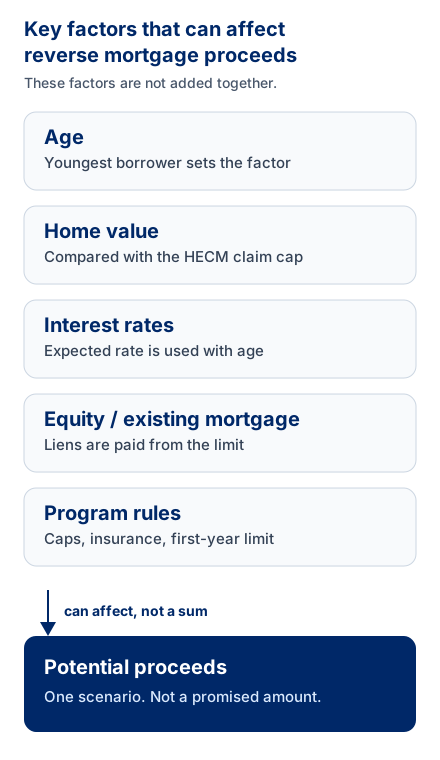
How this calculator works
Maximum claim amount = the lesser of your home value and $1,249,125. Principal limit = maximum claim amount × the HUD principal limit factor for the youngest borrower's age and your expected rate, rounded down to the nearest 1/8%. Factors come from HUD's current general PLF table.
Mandatory obligations = initial MIP (2% of the maximum claim amount) + origination fee at the HUD maximum + other closing costs + existing liens. Net available = principal limit − mandatory obligations. First-year cash is limited to the greater of 60% of the principal limit, or mandatory obligations plus 10%, minus the obligations themselves.
Tenure payments are illustrated to the youngest borrower's age 100 and term payments over the years you choose, both at the expected rate plus 0.5% annual MIP. Lender servicing set-asides, which can reduce payments slightly, are not included.
Sources. Maximum claim amount: HUD Mortgagee Letter 2025-22 (December 11, 2025) sets the HECM maximum claim amount at $1,249,125 for case numbers assigned January 1 through December 31, 2026. Read HUD Mortgagee Letter 2025-22 (opens hud.gov in a new tab). Principal limit factors: HUD's general PLF table for case numbers assigned on or after October 2, 2017. Mortgage insurance and origination-fee limits: HUD HECM rules. Last reviewed: September 2026.
What this estimate does not include: the lender's actual rate and margin; your appraised value; any set-aside the lender requires for property taxes and insurance after the financial assessment; required repairs; lender servicing set-asides; future rate changes on adjustable loans; the property taxes, insurance, HOA dues, and upkeep you keep paying; state or local costs; and proprietary (non-FHA) reverse mortgages.
Estimate only. Sample values are pre-filled. Replace them with your own. Results are not a loan offer, a quote, or a commitment to lend.
Frequently asked questions
›What is the 2026 reverse mortgage limit?
For FHA-insured HECM case numbers assigned in 2026, the maximum claim amount is $1,249,125, set by HUD Mortgagee Letter 2025-22. Proceeds are based on the lesser of your home’s appraised value and that limit.
›How much can I get from a reverse mortgage?
HUD sets a principal limit factor based on the youngest borrower’s age and the expected interest rate. Multiply it by the lesser of your home value and the national limit to get the principal limit. Closing costs, initial mortgage insurance, and any existing mortgage are paid from that amount first.
›Why can I only take part of the money in the first year?
HUD limits first-year disbursements to the greater of 60% of the principal limit, or your mandatory obligations (such as paying off a mortgage and closing costs) plus 10% of the principal limit. The rest becomes available after 12 months.
›What does a reverse mortgage cost?
Initial FHA mortgage insurance is 2% of the maximum claim amount, plus 0.5% a year on the balance. Lenders may charge an origination fee of the greater of $2,500 or 2% of the first $200,000 of value plus 1% above that, capped at $6,000. Third-party closing costs and interest also apply.
›Does the reverse mortgage line of credit grow?
Yes. On an adjustable-rate HECM, the unused portion of the line of credit grows at the same rate as the loan balance, the note rate plus the annual mortgage insurance rate. That growth is not interest paid to you and does not add equity to your home.
Related calculators and guides
Reverse Mortgages
How HECMs work, eligibility, and counseling.
How Much You Can Borrow
What a principal limit is, and why it is not the same as your equity.
Costs and Fees
Mortgage insurance, the origination cap, and charges that reduce cash.
Requirements
Age, occupancy, counseling, and the financial assessment.
Find a HUD-approved HECM counselor
Counseling is required before you can get a HECM.
Home Equity Calculator
Compare a HELOC, home equity loan, or cash-out refinance.
This material is not from HUD or FHA, and it was not approved by HUD, FHA, or any other government agency. National Mortgage Center and Stride Bank, N.A. are not affiliated with HUD or FHA.
This is not a loan offer. HECM borrowers must be 62 or older, occupy the home as a primary residence, complete HUD-approved counseling, and keep paying property taxes, homeowners insurance, and upkeep. The loan becomes due when the last borrower leaves the home, sells, or fails to meet loan terms. Consult a tax or benefits advisor about how proceeds may affect you.
Maximum claim amount source: HUD Mortgagee Letter 2025-22 (December 11, 2025).
Calculators provide educational estimates only. They are not a loan offer, credit decision, or commitment to lend. Actual terms depend on underwriting, credit, property, and program availability.
Equal Housing Lender · NMLS #466690